
We help apprentices and journeypersons across Canada walk into the exam ready. Here's what they say about it.

5.0 rated on
GSGurpreet S.Heavy Duty Equipment Technician
Red Seal resultPassed
79%first attempt
“Workugo helped me understand the questions, not just memorize answers.”
MNMarta NowakAutomotive Service Technician
Red Seal resultPassed
84%second attempt
“…the mock tests helped me see my weak areas”
ABAisha BennettCook
Red Seal resultPassed
81%first attempt
“…a way to revise without going back to college or sitting in long classes.”
AAnonymousVerified reviewer
Red Seal resultPassed
85%first attempt
“…I walked in knowing exactly what is expected from me.”
97%
Felt ready
on exam day
1256
Tradespeople studying
4.9/5
Client satisfaction rate
650+
Questions per trade
25
Red Seal trades
Used by tradespeople working at
In their own words
Hear it from tradespeople who passed
10 yearsin the trade
+$20/hrafter Red Seal
+$45/hrafter Red Seal
Yearsof schooling skipped
MW
Marcus W., Steamfitter/Pipefitter, Ontario
“Pipe is still pipe. What changed was the numbers.”
18 years in trade
Passed first try
Hello, I'm Marcus Weber. I'm a steamfitter-pipefitter in Sarnia, Ontario. I did my apprenticeship in Germany and came here as a trade qualifier. In Germany, I worked 18 years in chemical plants: process piping, steam lines, stainless and carbon steel. A lot of shutdown work.
The trade itself is the same here. Pipe is still pipe. What changed was the numbers. At home, everything is metric. Pipe sizes, wall thickness, measurements, all in millimetres. Here, it's nominal pipe size, schedules, and feet and inches down to the sixteenth. My first week, I worked out an offset in millimetres in my head and converted it. I was out by a quarter inch. The foreman had me cut it again. The 45-degree offset multiplier, 1.414, is the same everywhere. Everything around it was new to me.
People expect a qualifier from Germany to find the exam easy, because the training there has a good reputation. The training is good, but the exam is written for Canadian work. Canadian codes, imperial units, North American fittings and terms.
That's where WorkUgo helped. My first timed practice exam, I scored 64%. The results were broken down by topic, so I could see where the marks went: codes, pipe sizing and schedules, and the math in imperial. The explanations worked each calculation in feet and inches, so I learned to think in fractions of an inch. I studied about an hour most evenings for two months. My last practice exam was 88. I wrote the exam and passed.
If you trained in Europe, your skills carry over. Learn the units and the codes before you write, not after.
RK
Rajesh K., Heavy-Duty Equipment Technician, Alberta
“I knew the hydraulics. I was losing time converting in my head.”
14 years in trade
Passed on 3rd attempt
Hello, I'm Rajesh Kumar. I'm a heavy-duty equipment technician in Edmonton, Alberta. I came through as a trade qualifier from India. Back home, I worked 14 years on mining equipment: haul trucks, excavators, dozers. I have rebuilt final drives, transmissions, hydraulic pumps.
When I came to Canada, I thought the certification exam would be the easy part. I failed it twice. The first time, I was not close. The second time, I was closer, but still short. People assume if you fail, you don't know the trade. That was not my problem. My problem was the exam. The wording, the terms, the units. In India, I worked in bar and litres per minute. Many questions here used PSI and gallons per minute. I knew the hydraulics. I was losing time converting in my head and then second-guessing the answer.
A friend from my shift told me about WorkUgo. I started with the practice exams to see where I was losing marks: mostly hydraulic calculations like pump flow and cylinder force, and emissions aftertreatment, which our older machines back home did not have. The questions are written in the same style as the exam, and every wrong answer has an explanation. For the calculations, it shows each step with the units, so I learned to work in PSI directly instead of converting. I studied about one hour every evening for two months. On the third attempt, I passed.
If you are a qualifier coming from another country, your experience is real. Study the exam itself. Learn how the questions are asked, and learn the units they use here.
DR
Daniel R., Automotive Service Technician, Ontario
“In the shop, I read live data before I order parts now.”
4th-year apprentice
Practice 61% → 87%
Hi, I'm Daniel Reyes. I'm a fourth-year automotive service technician apprentice in London, Ontario.
Second year, I had a pickup come in with a check engine light and two lean codes. I replaced the mass airflow sensor, because that's what the internet said. The light came back in a week. My journeyman pulled up the live data and showed me the long-term fuel trims: around plus 18% at idle, close to normal at highway speed. He said that pattern usually means unmetered air. We put a smoke machine on it and found a split vacuum hose under the intake manifold. A $12 part.
Most people think the code tells you what part to replace. It doesn't. A lean code tells you the computer is adding fuel and still can't correct the mixture. Why is the diagnosis.
That's what I used WorkUgo for. The questions are sorted by system: engine management, fuel and ignition, brakes, steering and suspension, drivetrain, electrical. I spent most of my time on engine management and electrical, because that's where I was weakest. When I got one wrong, the explanation walked through the reasoning step by step, the same way my journeyman did with those fuel trims. My first timed practice exam, I scored 61%. I did about 20 minutes a night after work. My last one was 87.
In the shop, I read live data before I order parts now. Fewer comebacks, and I can explain the repair to the service advisor. If you're early in your apprenticeship, learn to read live data. The scan tool gives you a code. The data tells you what the engine is actually doing.
TH
Tyler H., Automotive Service Technician, Alberta
“Find out which topics are costing you marks and study those.”
Journeyperson
Passed on 3rd attempt
Hi, I'm Tyler Harmon. I'm a journeyperson automotive service technician in Red Deer, Alberta. Born and raised here. I wrote the Red Seal exam three times. The first attempt, I scored 61%. The second, 63. Barely moved the needle.
The shop floor wasn't the issue. I was the one the other techs came to for electrical and drivability problems. Part of it was what school prepared me for. The in-school training covered the theory. The Red Seal is harder. The questions give you a situation and ask what you'd do. You have to know the theory and how to apply it. That's the point. A journeyperson is supposed to be able to do both.
And I studied wrong. I reread the same textbook both times without knowing which areas were costing me marks. After the second attempt, a couple of guys at the shop had used WorkUgo for their own exams, and they told me to try it.
The first thing I did was a timed practice exam. The results were broken down by topic, and the pattern was clear: automatic transmissions and air conditioning. I rarely worked on either, and I'd been losing marks there both times. The questions were written as shop situations, and the explanations walked through how the theory applied to each one. I studied those two areas for about six weeks. On the third attempt, I passed with 79%.
My boss can take on more apprentices now, because there's another journeyperson to train them. He hired two this fall. If you failed it more than once, stop rereading everything. Find out which topics are costing you marks and study those.
MI
Mark I., Industrial Electrician, Manitoba
“Don't assume your experience covers everything.”
20 years in trade
Passed first try
Hi, I'm Mark. I'm an industrial electrician in Manitoba, and I've been in the trade 20 years. Most of that was maintenance: 12 years at a food processing plant, 8 at a mine up north. Motor controls, variable frequency drives, PLCs, conveyors, and a lot of troubleshooting at 3 in the morning.
Until recently, I didn't have my certificate. I applied as a trade qualifier and it stalled. My hours were spread across employers, some paperwork was missing, and nobody could tell me clearly what counted. The option on the table was to start as a fourth-year apprentice. Twenty years in. That didn't make sense to me. But I also didn't know where my real gaps were.
That's where WorkUgo came in. They went through my experience against what the trade covers and laid it out: what I could document, what I needed to document better, and what I hadn't done much of. For me, that was hazardous locations, high-voltage distribution and code calculations. In a plant, you mostly fix what's already there. You don't design much from scratch.
Then I used the practice questions for those areas. My first timed practice exam, I scored 63%. Almost everything I missed was code and calculations. I did about 40 minutes most evenings for three months. My last practice exam was 85. I wrote the exam and passed. No fourth year.
If you've been in the trade a long time without the certificate, don't assume your experience covers everything. Find out exactly what's missing and work on that.
JC
John C., Electrician, Ontario
“Get stuff wrong on a practice test, not in somebody's wall.”
Final-year apprentice
Practice 54% → 89%
Hey, I'm John Cartel. I'm a final-year electrical apprentice out of Mohawk College in Hamilton, Ontario.
So my first year, I stuffed so many wires into one box, the cover plate wouldn't sit flat. I leaned on it with my whole body. My journeyman watched, unscrewed it, and handed me a scrap of drywall and a pencil. “Do the box fill. Show me.” I couldn't do it. Not even close. That's when I figured out the code isn't paperwork. Every number in it is there because something went wrong once.
Now, people think you memorize the code book. You don't. Nobody does. What you learn is how to find things fast. That's what WorkUgo did for me. The practice questions are set up like real job problems. Get one wrong, and it tells you where in the book to look. So I'd go find it myself. A couple months in, my book had tabs everywhere.
The math was worse. My first timed calculation test, I got 54%. The worked solutions break every problem down step by step, so I could see exactly where I was blowing it. Usually the correction factor. Twenty minutes a night on the bus home, and my last practice exam was an 89.
Last month, I did box fill in my head on a job. My journeyman just nodded. From him? That's a parade. If you're a first-year and the book scares you, that's normal. Open it every day. Get stuff wrong on a practice test, not in somebody's wall.
R
Robert, Welder, Saskatchewan
“My hands were never the problem.”
16 years in trade
Passed first try
Hi, I'm Robert. I'm a welder in Regina, Saskatchewan. I came to Canada from the United States and went through as a trade qualifier. Back home, I welded pipe for 16 years, mostly in oil and gas. Stick welding, carbon steel, all positions: root pass, hot pass, fill, cap. My welds passed X-ray. My hands were never the problem. Honestly, I got fed up with the government policy back home and decided to make the move to Canada for a fresh start.
The problem showed up on my first job here. The drawings used weld symbols differently from what I learned. I read one as the other side of the joint and welded the wrong side of a bracket. My foreman caught it before it left the shop.
People assume a qualifier with years of experience will pass the written exam easily, but it covers a lot you don't touch every day: weld symbols, blueprint reading, metallurgy, preheat, and processes I had barely used, like flux-core and MIG.
That's where WorkUgo helped. I took a timed practice exam first to see where I stood. I scored 57%. The results were broken down by topic, so I could see it clearly: weld symbols and metallurgy, mostly. Every wrong answer had an explanation, and the symbol questions showed the drawing, so I learned to read them the way they're read here. I studied about an hour after shift, four days a week for 10 weeks. My last practice exam was 86. I wrote the exam and passed.
If you're coming from another country, learn how drawings and symbols are done here before your first job, not after.
How it works
From sign-up to your Red Seal
Four steps, from finding out where you stand to walking into the exam ready
01Take the free sample test
See where you stand
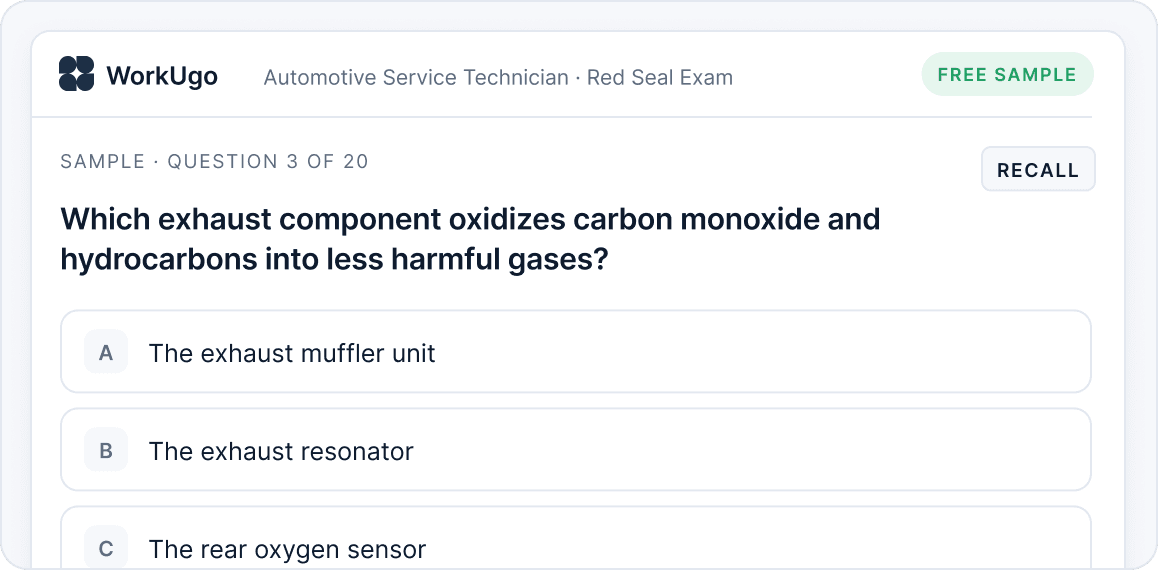
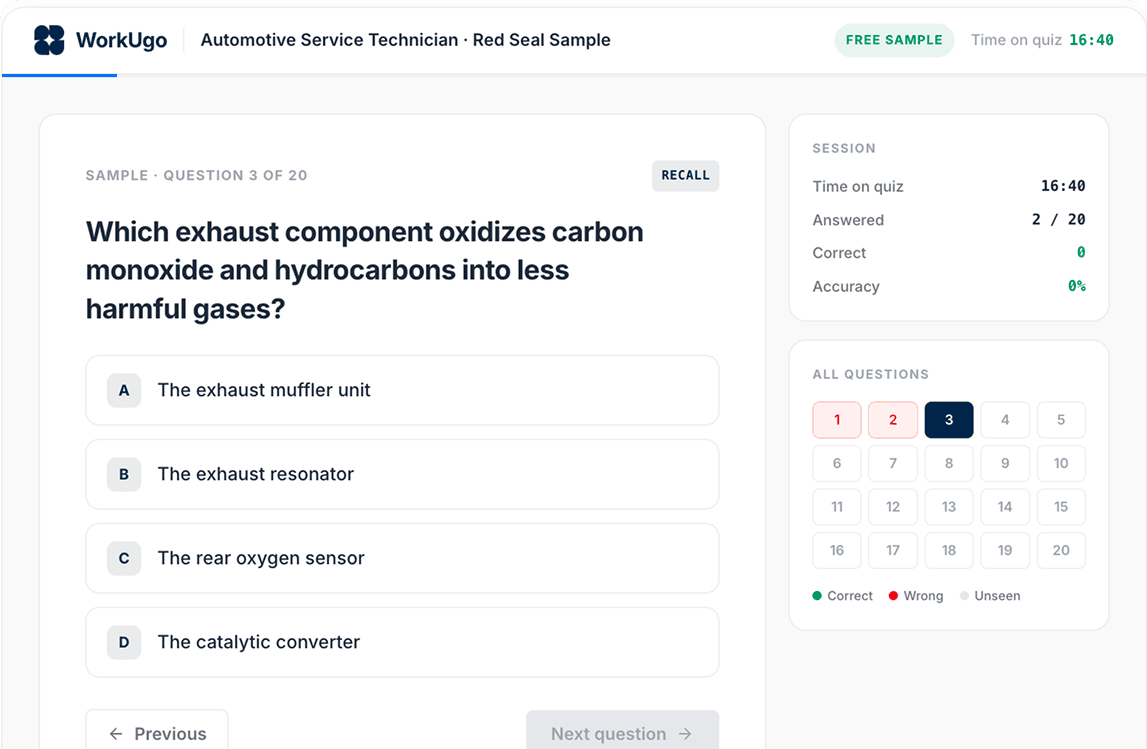
Pick your trade and answer 20 exam-style questions, with no sign-up. Your results come back block by block, so you know your strong and weak areas before you pay anything.
A
“Format matched real exam closely…”
Verified review
02Choose your plan
Unlock the full bank for your trade
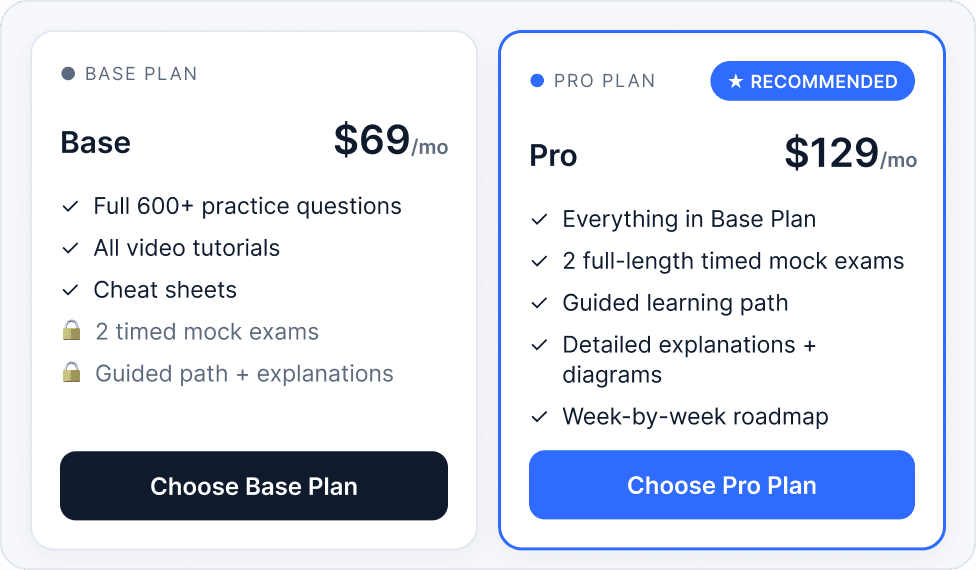
Base gives you the 600+ question bank, video tutorials and cheat sheets. Pro adds detailed explanations, mock exams and a guided path. Month to month, cancel anytime.
KC
“Great tool and affordable.”
Verified review
03Fix your weak spots
Down to the sub-task
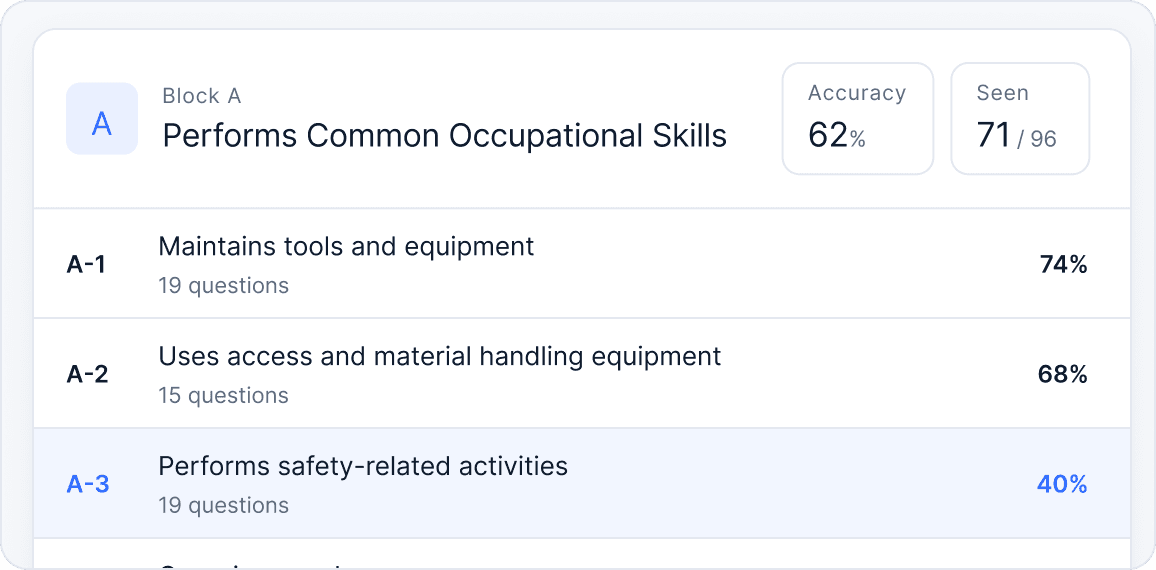
Most prep tells you you’re weak at “electrical.” We tell you it’s A-3, safety-related activities, 19 questions, and you’re sitting at 40%. Every answer explains why.
NK
“This platform showed my mistakes clearly…”
Verified review
04Write your Red Seal
Book when your number says so
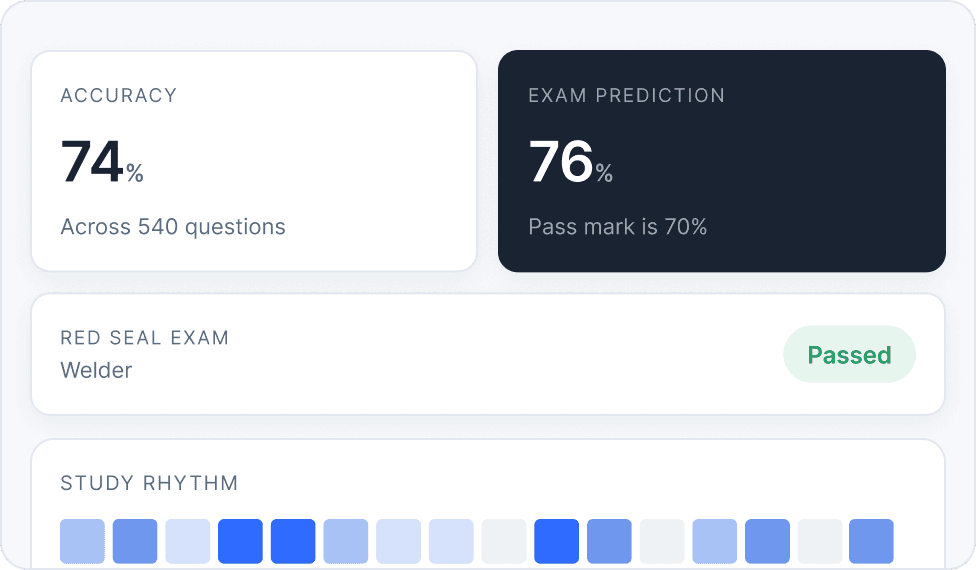
Sit timed mock exams in exam mode. Your prediction moves with every session, so you book the real exam when you’re above the pass mark, not when you’re hoping.
A
“Passed. Can work anywhere in Canada now.”
Verified review
Check what the media say about WorkUgo
See where WorkUgo has been covered and what we've announced along the way.
1 / 7

Press release ·
WorkUgo Launches Upgraded Red Seal Exam Preparation Platform for Skilled Trades Workers in Canada
Announces WorkUgo 2.0: exam-grade practice questions for each trade, written by former Red Seal instructors and journeypersons, plus mock exams, cheat sheets and video tutorials.
WorkUgo Expands Global Reach to Bridge Skilled Trades Gaps and Strengthen Leadership Team
Backed by pre-seed funding from Digital Future Venture Fund, WorkUgo brings in former Randstad Canada VP Ian Yule and AmbiMi founder Jeffrey David Harris as it expands across Latin America, Africa and Southeast Asia.
Fewer than 20% of apprentices reach certification. WorkUgo wants to change that
Co-founder Andrew Malenkov on Canada’s trades gap: over 700,000 tradespeople are expected to retire by 2028, and he argues the real issue is access to certification, not a lack of talent.
Live Cohorts by WorkUgo: Instructor-Led Red Seal Exam Classes Added to Exam Preparation and Career Companion Platform
Tradespeople can now study in groups of 15 to 25 from the same trade, with eight weeks and 21 live hours led by a certified Red Seal instructor, framed by two scored mock exams.
WorkUgo Launches to Tackle Skilled Trades Shortages in Developed Economies
The launch announcement: former Just Eat Takeaway product lead Andrew Malenkov and entrepreneur Oleksii Vitchenko on why the trades gap is about access, not talent.
WorkUgo Strengthens Executive Team to Power Skilled Trades Mobility in Canada
Jeffrey David Harris joins to advise on product strategy, bringing AI-powered vetting and mobile-first job matching to improve the candidate experience.
Frequently Asked Questions
Find answers to the most common questions about our platform, features, and services. If you need more help, feel free to reach out to our support team.
Yes. WorkUgo is a Canadian skilled trades platform backed by Digital Future Venture Fund. Our Red Seal practice questions are written by former Red Seal instructors and experienced journeypersons, and tradespeople rate us 5.0 out of 5 on Reviews.io.
Does WorkUgo cover my trade?
+
We cover 25+ Red Seal trades, including Electrician, Plumber, Carpenter, Millwright, Heavy Duty Equipment Technician, Automotive Service Technician, Truck and Transport Mechanic and Cook. Pick your trade on the free sample test to see the questions for your exam.
Can I study on my phone?
+
Yes. WorkUgo works in your phone's browser, so you don't need a laptop. Many tradespeople study in short sessions on lunch breaks, between jobs or after a shift, and your progress saves where you left off.
Who writes the practice questions?
+
Certified Red Seal tradespeople: former Red Seal instructors and journeypersons with years on the tools. Every question follows the current Red Seal Occupational Standard for your trade and is weighted the way the real exam is.
How long before my exam should I start?
+
It depends on how much you already know. Our free 20-question sample test shows where you stand in about 15 minutes. Many reviewers studied for four weeks to three months, often in short sessions on their lunch breaks. If your exam is close, start with the blocks that carry the most questions.
Do you offer a money-back guarantee?
+
Yes. If you change your mind, email us within 7 days of your first payment and we'll refund it in full. No reason needed, and using the platform during those 7 days doesn't affect your refund. A single mock exam bought on its own is refundable within 7 days, as long as you haven't opened it. Monthly renewals aren't refunded, but you can cancel anytime from your profile and keep access until the end of the month you paid for.
See where you stand
in 20 questions
Take a free sample test for your trade. No sign-up, results by block at the end.